
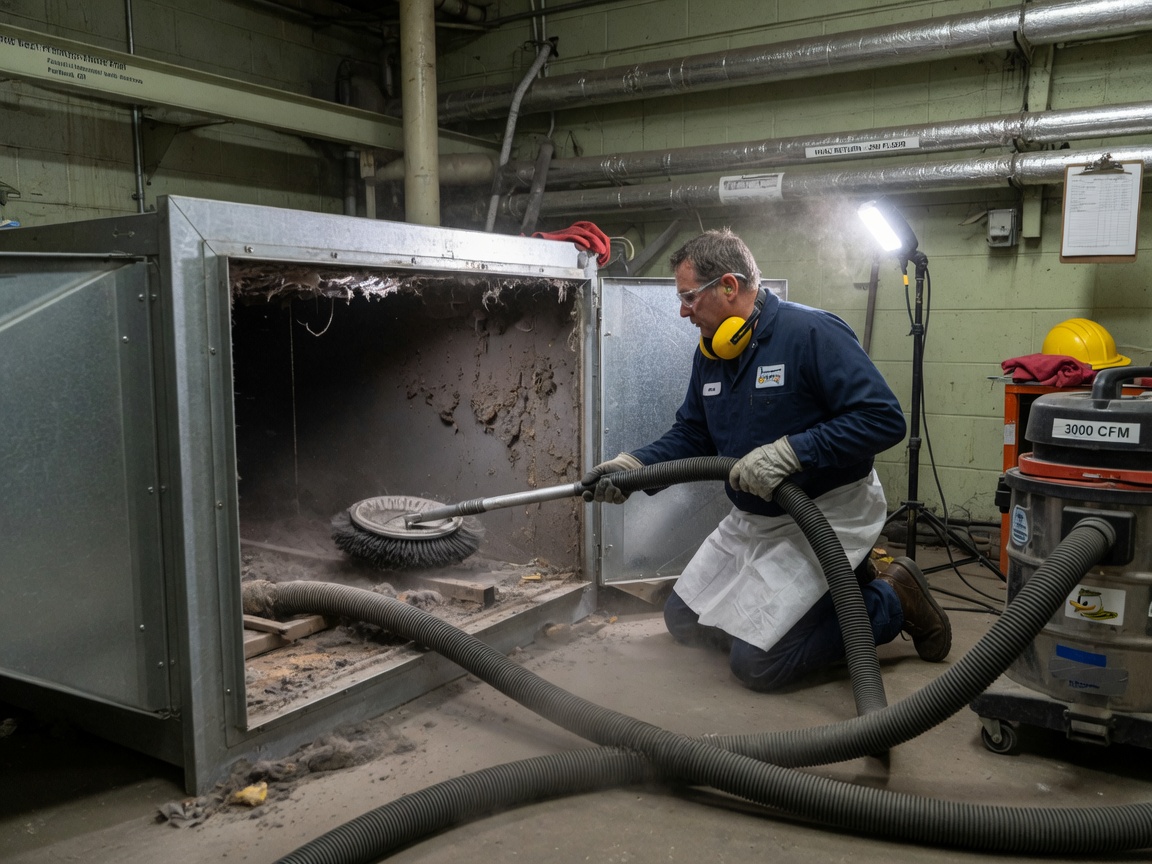
Industrial facilities in Oregon City often operate in older brick and steel buildings along the Willamette River corridor in Clackamas County. These structures frequently contain long runs of sheet-metal ductwork that accumulate fine dust, metal shavings, and paper fibers from local manufacturing. Wet winters increase condensation inside uninsulated lines, creating conditions where mold can form on interior surfaces and affect air quality throughout the plant.
Technicians begin by mapping every branch and access point because many older Oregon City industrial sites have been expanded multiple times without updated blueprints. High-velocity negative-air machines are connected at multiple points to prevent cross-contamination between production zones. Special attention is paid to rooftop exhaust fans that pull moist air from the river valley, as these units trap debris that later falls back into the system during heavy rain events.
Access limitations are common in Clackamas County warehouses where machinery sits directly beneath main trunk lines. Crews use sectional rods and camera inspection to clean around obstacles without shutting down entire operations. Post-cleaning verification includes airflow readings at key registers to confirm the system moves the volume required for code compliance in industrial spaces.
Technician insight
In Oregon City the thing that catches most people out with industrial air duct cleaning is how quickly river moisture condenses inside uninsulated rooftop ducts during the long wet season. Older Clackamas County buildings often have trunk lines that were never designed for modern filtration loads, so debris travels farther before it settles.
Paper-Products Warehouse Near the Falls
Fine white dust from packaging lines had built up in the main supply trunks of a single-story warehouse off 99E. Camera inspection showed heavy accumulation at every elbow where the duct turned toward the production floor. Negative-air machines were staged on the roof and at two interior access points so the line could keep running. After agitation and extraction, measured airflow at the registers increased enough that the facility manager could reduce fan speed settings.
Industrial Air Duct Cleaning Services We Offer
✓Factory Production Line Duct Cleaning
Removes fine particulate and process residue from ducts serving active manufacturing lines without halting operations.
✓Warehouse Ventilation System Restoration
Clears accumulated dust and debris from large-volume warehouse duct networks to restore designed airflow rates.
✓Rooftop Exhaust Fan and Duct Cleaning
Targets rooftop units common on Oregon City industrial buildings where river moisture accelerates buildup inside exhaust paths.
✓Process Dust Collection Duct Service
Cleans dedicated dust-collection ductwork in woodworking, metal, and paper facilities around Clackamas County.
✓Loading Dock and Bay Area Duct Cleaning
Addresses high-traffic dock areas where vehicle exhaust and outdoor debris enter supply and return lines.
Industrial Air Duct Cleaning Cost in Oregon City, OR
| Service | Typical Range | What Affects It |
|---|---|---|
| Small industrial system under 2,000 linear feet | $1,800–$3,200 | Single-story warehouse with good roof access |
| Mid-size facility 2,000–5,000 linear feet | $3,400–$6,500 | Multiple zones and some overhead obstructions |
| Large multi-story or complex layout | $7,000–$12,000 | Requires phased scheduling around shifts |
| Rooftop exhaust fan add-on | $450–$850 per unit | Includes fan housing and connected trunk section |
Ranges are typical for Oregon City, OR and confirmed with an exact written quote before any work starts.
How it works
- 1
Site Assessment and Mapping
Walk the facility to locate every trunk, branch, and access panel while noting production constraints.
- 2
Negative-Air Setup
Position HEPA-filtered machines at multiple points to contain dust during cleaning.
- 3
Mechanical Agitation and Extraction
Use brushes, air whips, and compressed air to dislodge debris while vacuuming it out of the system.
- 4
Post-Clean Verification
Inspect with cameras and measure airflow at registers to confirm performance.
Pricing
Cost depends on total linear feet of duct, number of access points required, and whether production must continue during work.